
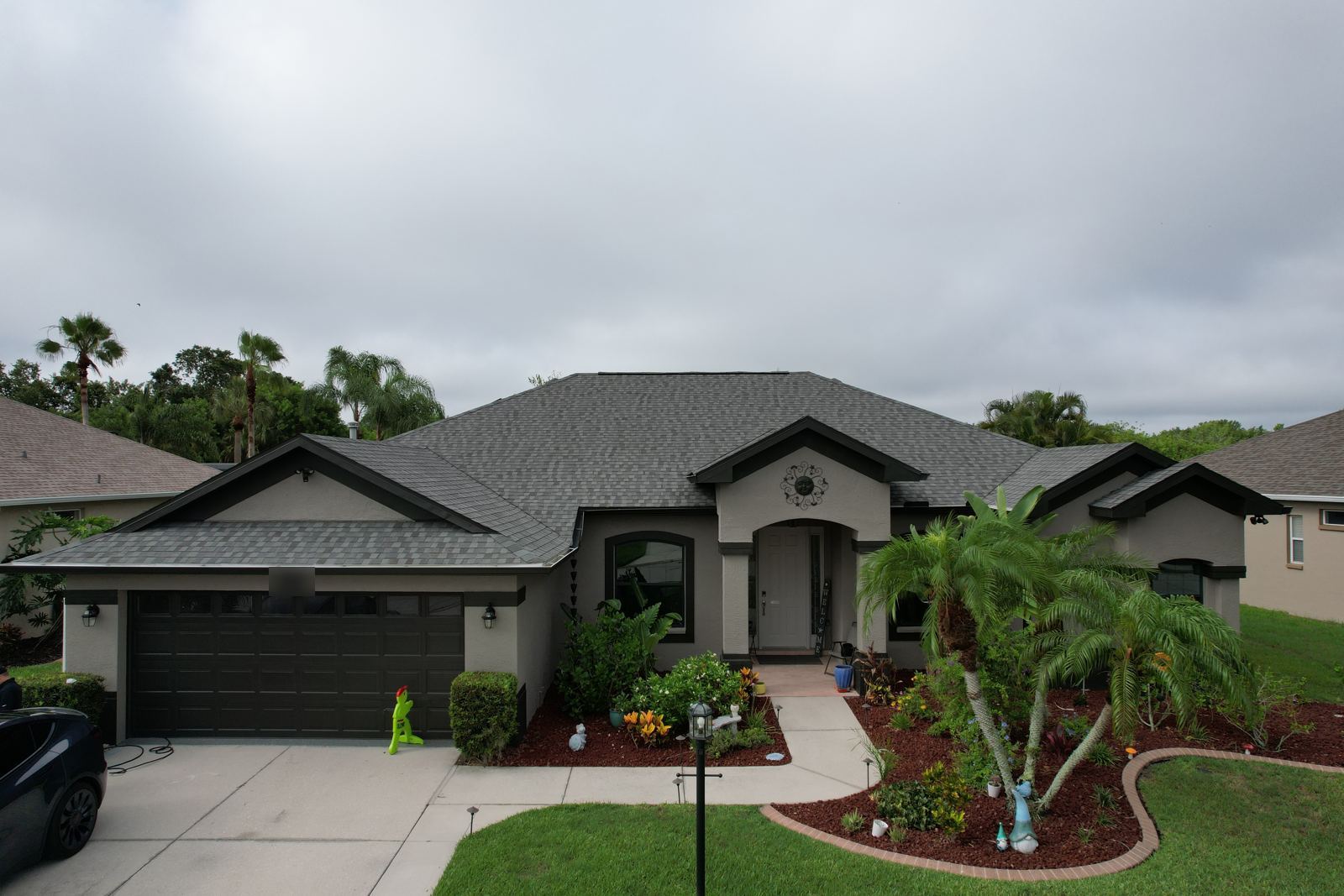
Florida-specific warning: 3-tab shingles are rated to 60–80 mph wind resistance. Florida regularly experiences tropical storm force winds (39+ mph) and hurricane-force winds (74+ mph). We do not recommend 3-tab shingles for Florida homes.
Not sure which shingle is right for your home? Ask our team for a free, no-pressure recommendation, or get a free roof cost estimate online.
If you’re replacing your roof in Florida and comparing asphalt shingle options, the architectural vs 3-tab decision is one of the most commonly asked questions we get, and one that has a clear answer for most Florida homeowners. This guide explains the differences, why they matter in Florida’s climate, and which option to choose for your specific situation.
Architectural vs 3-Tab Shingles: Side-by-Side Comparison
| Factor | 3-Tab Shingles | Architectural Shingles |
|---|---|---|
| Construction | Single layer, flat profile | Multi-layer, dimensional |
| Weight | ~240 lbs per square | ~320–400 lbs per square |
| Wind Resistance | 60–80 mph | 110–150 mph |
| Florida Lifespan | 10–15 years | 15–20 years |
| Appearance | Flat, uniform profile | Dimensional, premium look |
| Insurance Credits | Minimal | Better wind mitigation credits |
| Cost (installed) | $8,000–$12,000 | $9,000–$16,000 |
| HOA Acceptance | Limited | Widely accepted |
| Florida Recommendation | Not recommended | Recommended |
What Are 3-Tab Shingles?
3-tab shingles get their name from the three cutouts (tabs) along the exposed lower edge of each shingle. They’re the original standard asphalt shingle design, single-layer, flat profile, and uniform appearance. They were the dominant residential roofing product in the United States through most of the 20th century.
In Florida, 3-tab shingles have largely been replaced by architectural shingles on new construction and re-roofing projects, for good reason. Their single-layer construction and lighter weight mean they are far more vulnerable to hurricane-force winds. Their flat tab design creates more uplift surface during high-wind events, and the individual adhesive strips are less resistant to wind-driven rain intrusion.
Why 3-Tab Shingles Are a Poor Choice for Florida
- Wind rating of 60–80 mph: inadequate for a state where tropical storm force winds (39+ mph) occur multiple times per year
- Shorter Florida lifespan: 10–15 years in real Florida conditions due to UV, heat cycling, and hurricane season stress
- Minimal wind mitigation credits: 3-tab shingles earn the lowest possible roof covering credits on Florida wind mitigation reports, meaning minimal insurance discounts
- Aesthetic limitations: the flat, uniform profile is considered dated and may not meet HOA standards in newer Florida communities
- Post-storm availability: after major Florida storms, 3-tab shingles become difficult to source as demand spikes for higher-grade materials
What Are Architectural Shingles?
Architectural shingles (also called dimensional shingles or laminate shingles) are a significant upgrade from 3-tab. They feature a multi-layer construction that bonds two or more layers of shingle material together, creating a dimensional profile that mimics the appearance of wood shake or slate. The thicker, heavier construction improves wind resistance and extends the shingle’s effective lifespan.
Architectural shingles became the dominant residential roofing product in Florida following the 2004–2005 hurricane seasons, as building codes were updated to require better wind resistance and homeowners recognized the performance gap.
Standard Architectural Shingles in Florida
Standard architectural shingles, GAF Timberline HDZ, Owens Corning Duration, CertainTeed Landmark, represent the baseline for Florida residential roofing today. They offer:
- Wind resistance rated to 110–130 mph depending on fastener pattern
- Dimensional appearance that meets most Florida HOA requirements
- Florida lifespan of 15–20 years in real conditions
- Moderate wind mitigation credits for insurance purposes
- Broad availability after storm events
Impact-Resistant Class 4 Architectural Shingles in Florida
The best upgrade within the asphalt shingle category for Florida homeowners is impact-resistant (IR) Class 4 architectural shingles. These include GAF Armor Shield II, Owens Corning Duration Storm, and CertainTeed NorthGate SBS. Class 4 shingles offer:
- Wind resistance rated to 130–150 mph
- UL 2218 Class 4 impact resistance rating, the highest classification
- Better wind mitigation credits: qualifying for superior roof covering credit on the OIR-B1-1802 form
- Florida lifespan of 20–25 years
- Potential insurance premium reductions of 10–20%
- Modest cost premium over standard architectural shingles, typically $500–$1,500 more installed
For Florida homeowners choosing asphalt shingles, Class 4 impact-resistant architectural shingles are the clear recommendation. The insurance savings alone typically recover the cost premium within 3–5 years.
How Florida Building Codes Treat 3-Tab vs Architectural Shingles
Florida Building Code (FBC) requires roofing materials to meet specific wind uplift resistance standards based on the wind exposure category of your location. In most of Manatee, Sarasota, Hillsborough, and coastal counties, the design wind speed requirements now effectively make standard 3-tab shingles non-compliant for new installation on homes near the coast.
When you replace a roof in Florida, the permit requires documentation that the installed roofing system meets current wind uplift standards. Architectural shingles installed with the correct fastener pattern (6 nails per shingle in high-wind zones) meet current FBC requirements. Standard 3-tab shingles often do not.
Wind Mitigation Impact: Architectural vs 3-Tab
Florida law requires insurance companies to offer premium discounts for homes with qualifying wind mitigation features. The roof covering type is one of the scored categories on the OIR-B1-1802 wind mitigation form. Here’s how the two shingle types stack up:
| Shingle Type | Wind Mitigation Credit Level | Typical Insurance Impact |
|---|---|---|
| 3-Tab (non-rated) | Lowest | Minimal to no discount |
| Standard Architectural | Moderate | Some discount available |
| Impact-Resistant Class 4 | Superior | 10–20% premium reduction |
Ask iDEAL Home Solutions about a wind mitigation inspection when your roofing project is complete; the OIR-B1-1802 form it produces is what your insurer uses to apply any discount. Timing for the discount to appear depends on your insurer.
Cost Comparison: 3-Tab vs Architectural in Florida (2026)
| Shingle Type | Installed Cost (2,000 sq ft) | Florida Lifespan | Cost Per Year |
|---|---|---|---|
| 3-Tab | $8,000–$12,000 | 10–15 years | $620–$900/yr |
| Standard Architectural | $9,000–$14,000 | 15–20 years | $525–$785/yr |
| Class 4 Impact-Resistant | $10,000–$16,000 | 20–25 years | $480–$680/yr |
When you calculate cost per year of useful life in Florida’s conditions, 3-tab shingles are actually the most expensive option, not the cheapest. Class 4 impact-resistant architectural shingles deliver the lowest real cost per year of protection, plus insurance savings that further reduce the effective cost.
When Might 3-Tab Shingles Still Make Sense?
In most Florida situations, they don’t, but there are limited exceptions:
- Matching an existing 3-tab roof for a small section repair on an older home where appearance match matters more than performance
- Temporary cover on a structure you plan to demolish or substantially renovate within a few years
- Very low-pitch outbuildings or structures outside the main home where wind exposure is lower and insurance isn’t a factor
For your primary Florida home’s roof, there is no situation where 3-tab shingles are the right choice over architectural shingles.
Top Architectural Shingle Recommendations for Florida
GAF Timberline HDZ (Standard Architectural)
The most-installed shingle in Florida. Dual-layer construction, StainGuard Plus algae protection, Layerlock technology for wind adhesion rated to 130 mph. Wide variety of colors for Florida aesthetics. Good post-storm availability.
GAF Armor Shield II (Class 4 Impact-Resistant)
iDEAL’s recommended impact-resistant upgrade for Florida homeowners choosing shingles. UL 2218 Class 4 rating. Earns superior roof covering wind mitigation credit. Available in popular Florida color profiles.
Owens Corning Duration Storm (Class 4)
Another solid Class 4 option with SureNail technology for strong wind adhesion. Good post-hurricane track record across the Southeast.
Frequently Asked Questions About Architectural and 3-Tab Shingles
What is the difference between architectural and 3-tab shingles?
Architectural shingles are multi-layer, heavier, dimensionally textured, and rated to 110–150 mph wind resistance. 3-tab shingles are single-layer, lighter, flat-profile, and rated to only 60–80 mph. In Florida’s hurricane climate, architectural shingles are the appropriate choice for any residential application.
Are 3-tab shingles allowed in Florida?
They may technically meet minimum code in some low-wind areas, but are generally not recommended and in many coastal Florida counties do not meet current Florida Building Code wind uplift requirements for new installation. We do not install 3-tab shingles on Florida homes.
How long do architectural shingles last in Florida?
Standard architectural shingles last 15–20 years in real Florida conditions. Class 4 impact-resistant architectural shingles last 20–25 years. Both fall short of their national warranty ratings due to Florida’s UV, heat, and hurricane season exposure.
Do architectural shingles lower my insurance in Florida?
Class 4 impact-resistant architectural shingles earn better wind mitigation credits than standard architectural shingles and can reduce your Florida wind insurance premium by 10–20%. Standard architectural shingles earn moderate credits. 3-tab shingles earn minimal to no credits.